Factory Ventilation Systems: Learn About Airflow Design, Equipment and Industrial Applications
A factory ventilation system is a planned arrangement of fans, ducts, air inlets, exhaust equipment, filters, and controls used to manage air movement inside industrial buildings.
It can help remove heat, dust, fumes, vapors, moisture, and other airborne contaminants while introducing suitable amounts of outside air. Factory ventilation systems are used across manufacturing plants, warehouses, workshops, processing facilities, laboratories, and other industrial environments where indoor air conditions can change during production.
Context
What Is a Factory Ventilation System?
A factory ventilation system controls the movement and exchange of air within an industrial facility. Unlike ordinary room ventilation, industrial systems are designed around production activities, equipment layouts, heat generation, airborne materials, building dimensions, and worker locations.
Ventilation can be either natural or mechanical. Natural ventilation uses openings such as windows, roof vents, louvers, and architectural openings to encourage air movement. Mechanical ventilation uses powered fans, blowers, ductwork, dampers, filters, and exhaust equipment.
A factory may use one ventilation approach or combine several systems. The appropriate arrangement depends on the building and the materials generated during production.
How Factory Ventilation Works
The basic principle is to move unwanted or contaminated air away from occupied and production areas while introducing suitable replacement air. In some facilities, air is exhausted directly outdoors; in others, it passes through filtration or treatment equipment before discharge.
A typical mechanical system can include:
Fresh-air intake points
Supply fans
Exhaust fans
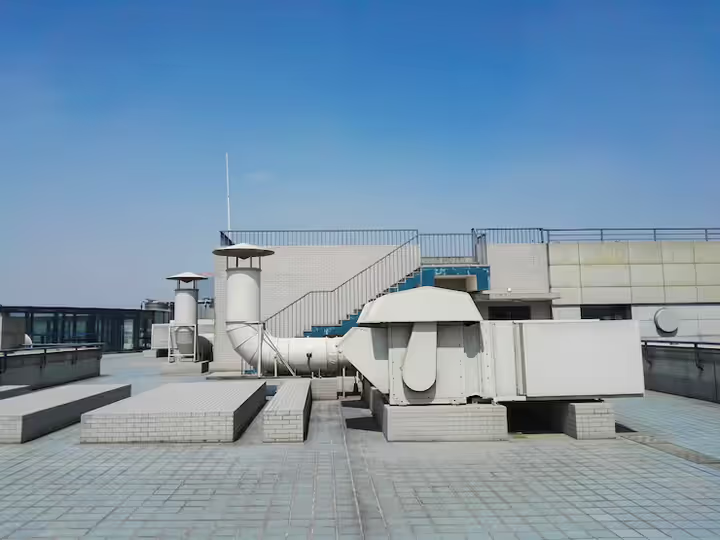
Ductwork
Dampers
Air filters
Local exhaust hoods
Roof ventilators
Air-cleaning equipment
Temperature and pressure sensors
Automated control panels
The design of each component depends on airflow requirements and the type of manufacturing activity.
General Ventilation and Local Exhaust
General ventilation circulates or replaces air throughout a larger area. It can help manage overall temperature, humidity, and background airborne contaminants.
Local exhaust ventilation focuses on a particular source. A hood positioned near a welding station, chemical process, grinding operation, or dust-generating machine can capture contaminants before they spread throughout the factory.
Local exhaust is particularly important when a production process creates concentrated airborne contaminants.
Common Types of Factory Ventilation
Several ventilation arrangements are used in industrial buildings. Supply ventilation introduces outside air through fans or air-handling equipment. Exhaust ventilation removes indoor air and creates an airflow path toward exhaust points.
Balanced ventilation combines controlled supply and exhaust airflow. Local exhaust ventilation captures contaminants close to their source. Natural ventilation relies primarily on wind and temperature differences rather than powered equipment.
Large facilities may combine these approaches to accommodate different production zones.
Importance
Managing Indoor Air Conditions
Industrial processes can generate heat, humidity, dust, fumes, vapors, and airborne particles. Without appropriate air movement, these contaminants may accumulate within the building.
A properly designed Factory Ventilation System can help maintain suitable indoor conditions by controlling airflow and removing unwanted airborne materials. The actual performance depends on system design, maintenance, building configuration, and production activity.
Supporting Workplace Conditions
Workers can spend many hours inside manufacturing facilities. Indoor temperature, humidity, airborne contaminants, and air movement can influence working conditions.
Ventilation is therefore an important component of industrial workplace planning. It works alongside equipment enclosures, personal protective equipment, housekeeping, process controls, and other measures.
Controlling Heat
Industrial machinery, furnaces, ovens, compressors, motors, and production processes can release substantial heat. If this heat is not managed, indoor temperatures can rise.
Factory ventilation can remove heated air and introduce cooler outside air when environmental conditions permit. In facilities with high heat loads, ventilation may be combined with mechanical cooling or other thermal-control methods.
Managing Dust and Fumes
Manufacturing processes such as cutting, grinding, welding, mixing, coating, and material handling can generate airborne contaminants. Local exhaust systems can capture contaminants close to their source.
The design should consider the contaminant type, generation rate, source location, airflow direction, and required capture velocity. Specialized engineering analysis may be necessary for hazardous substances.
Energy and Building Performance
Ventilation systems use electrical energy through fans, motors, pumps, and associated equipment. Excessive airflow can increase energy use, while insufficient airflow can create inadequate indoor conditions.
Modern systems may use variable-speed drives, sensors, automated dampers, and demand-based controls to adjust airflow according to operating conditions.
| Ventilation Type | Main Function | Typical Industrial Application |
|---|---|---|
| Natural ventilation | Uses openings and pressure differences | Warehouses and suitable workshops |
| Supply ventilation | Introduces outside air | General factory areas |
| Exhaust ventilation | Removes indoor air | Heat or contaminant removal |
| Balanced ventilation | Controls supply and exhaust | Enclosed manufacturing areas |
| Local exhaust | Captures contaminants at source | Welding and chemical processes |
| Roof ventilation | Releases hot or rising air | Large industrial buildings |
Design Factors
A Factory Ventilation System should account for several physical and operational conditions. Important factors include:
Building volume and ceiling height
Number of workers
Heat generated by machinery
Type and quantity of airborne contaminants
Production layout
Outdoor climate
Required airflow
Equipment operating schedules
Filter requirements
Pressure relationships between rooms
Airflow should also be arranged so that contaminated air does not move from a process area toward cleaner areas.
Recent Updates
Greater Use of Automated Controls
From 2024 through 2026, industrial ventilation has continued incorporating digital sensors and automated controls. Temperature, humidity, pressure, particulate levels, and equipment status can be monitored electronically where appropriate.
Control systems can adjust fan speeds or dampers according to measured conditions. This can make ventilation more responsive to changing production activity, although sensors require appropriate calibration and maintenance.
Energy-Focused Ventilation
Industrial facilities are paying increasing attention to energy management. Variable-frequency drives can adjust fan speed rather than keeping motors at a single operating level under all conditions.
Demand-controlled ventilation can also use occupancy, temperature, air-quality, or process information to modify airflow. The suitability of such controls depends on the contaminants involved and the safety requirements of the process.
Improved Filtration
Air filtration technology continues to develop for applications involving particulate matter, dust, aerosols, and specific industrial contaminants. Filter selection depends on particle characteristics, airflow, pressure drop, temperature, and the required level of filtration.
Industrial filtration systems can include different filter stages, dust collectors, cartridge systems, bag filters, or specialized filtration arrangements.
Digital Monitoring and Maintenance
Connected ventilation systems can collect information about fan speed, motor condition, filter pressure drop, temperature, and airflow. These measurements can help identify changes that require inspection.
Maintenance teams can use digital records to track filter replacement, fan inspections, belt condition, bearing condition, and other equipment activities.
Greater Integration With Factory Automation
Ventilation controls can increasingly interact with broader building-management and industrial-control systems. For example, ventilation equipment may respond to production status, room pressure, temperature, or process alarms.
Integration requires appropriate cybersecurity, control logic, sensor reliability, and fail-safe arrangements, particularly when ventilation is associated with hazardous processes.
Laws or Policies
Workplace Safety in India
Factory ventilation in India is influenced by workplace health and safety requirements. The Occupational Safety, Health and Working Conditions Code, 2020 forms part of the national framework concerning occupational health, safety, and working conditions, subject to its applicability and implementation framework.
Factories may also need to comply with applicable state-level requirements and rules associated with their industrial activities.
Airborne Contaminants
Where manufacturing processes generate dust, fumes, vapors, gases, or other airborne contaminants, facilities may need appropriate engineering controls. The required controls depend on the material, concentration, process, exposure conditions, and applicable occupational requirements.
Ventilation should not be considered a substitute for other necessary controls when hazardous materials are involved.
Environmental Requirements
Industrial exhaust can also fall under environmental regulations. Facilities may need to consider emissions, particulate matter, chemical releases, and other pollutants under applicable environmental rules.
The Central Pollution Control Board and State Pollution Control Boards administer various environmental requirements in India. Exact obligations depend on the facility, industry, process, and location.
Fire and Electrical Safety
Fans, motors, electrical panels, ducts, filters, and other ventilation components must be considered within the facility's fire and electrical safety arrangements. Processes involving flammable vapors or combustible dust can require additional engineering controls.
The appropriate design depends on the material and process. Relevant fire, electrical, and industrial standards should be identified during facility planning.
Tools and Resources
Airflow Calculations
Engineers can use airflow calculations to estimate the volume of air that needs to be moved through a facility. Building volume, required air changes, contaminant generation, heat loads, and local capture requirements can all influence calculations.
Air changes per hour can provide a general planning metric, but local exhaust applications often require more detailed analysis based on source capture.
Ventilation Design Software
Computational fluid dynamics software can model air movement inside industrial buildings. Such analysis can help examine airflow patterns, temperature distribution, contaminant movement, and equipment placement.
Computer-aided design platforms are also commonly used to prepare duct layouts, equipment locations, and ventilation schematics.
Monitoring Equipment
Useful measurement tools can include:
Anemometers for air velocity
Differential-pressure gauges
Temperature sensors
Humidity meters
Particulate monitors
Airflow measurement devices
Pressure sensors
Filter pressure indicators
The appropriate instruments depend on the ventilation system and process.
Standards and Technical Resources
ASHRAE publications, ISO standards, national building requirements, occupational safety guidance, and industrial ventilation references can support ventilation planning. Indian facilities should also review applicable BIS standards and regulatory guidance.
Technical documentation should be matched to the specific facility rather than applying a single airflow value to every industrial building.
FAQs
What is a Factory Ventilation System?
A Factory Ventilation System is an arrangement of fans, ducts, air inlets, exhaust equipment, filters, controls, and related components used to manage air movement and indoor conditions in an industrial facility.
What are the main types of Factory Ventilation Systems?
Common types include natural ventilation, supply ventilation, exhaust ventilation, balanced ventilation, and local exhaust ventilation. A factory can use several types within different production areas.
Why is local exhaust important in a Factory Ventilation System?
Local exhaust captures dust, fumes, vapors, or other contaminants close to where they are generated. This can limit the movement of contaminants into surrounding areas when the system is correctly designed and maintained.
How is airflow calculated for a Factory Ventilation System?
Airflow requirements can depend on building volume, heat generation, occupancy, contaminant generation, local capture requirements, and applicable standards. Industrial ventilation design may require detailed engineering calculations rather than a single general formula.
How can factory ventilation systems be monitored?
Sensors and instruments can measure airflow, pressure, temperature, humidity, particulate levels, and equipment conditions. Digital control systems can collect this information and display operating conditions for inspection and maintenance.
Conclusion
A Factory Ventilation System manages air movement, heat, humidity, dust, fumes, and other indoor conditions within industrial facilities. General ventilation and local exhaust systems serve different purposes, and many factories combine multiple approaches according to their production processes. Developments from 2024 through 2026 have included greater use of sensors, automated controls, energy monitoring, improved filtration, and digital maintenance records. Proper ventilation planning requires consideration of building characteristics, process hazards, workplace requirements, environmental rules, and equipment design.