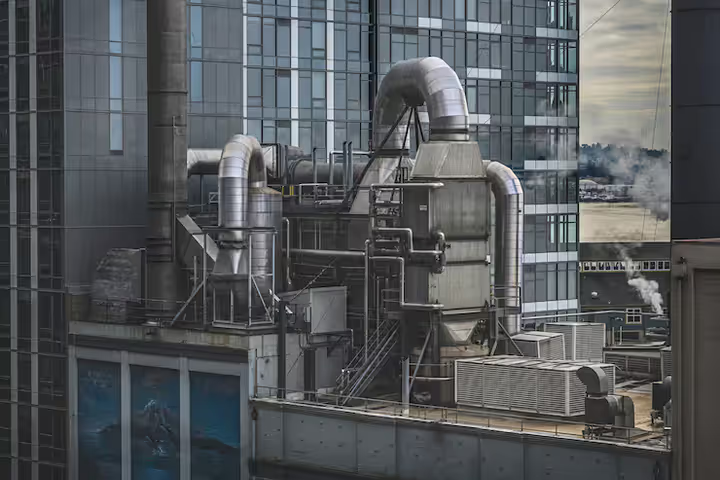
Industrial Dust Collectors Explained: How Dust Filtration Systems Work
Industrial dust collectors are systems designed to capture airborne dust, particles, and other solid contaminants generated during manufacturing and processing activities. Industrial dust collection systems are commonly used in woodworking, metalworking, cement production, food processing, pharmaceuticals, chemicals, and other industrial environments.
By moving contaminated air through filtration equipment, these systems help manage particulate matter and maintain controlled working conditions.
Industrial dust extraction systems can range from a single collection unit connected to one machine to central dust collection systems serving multiple production areas. The design depends on the type and quantity of dust, airflow requirements, particle characteristics, equipment layout, and applicable environmental and workplace requirements.
Context
What Are Industrial Dust Collectors?
An industrial dust collector is an air-cleaning system that separates solid particles from an air stream. Dust-producing equipment generates airborne particles, and a collection system draws the contaminated air toward a filter or separation device.
The basic process generally involves four stages: contaminated air enters the collection system, larger particles are separated or captured, finer particles pass through filtration media, and treated air leaves the filtration unit.
Different industries produce different types of particulate matter. Woodworking can generate sawdust and fine wood particles, while metalworking may produce grinding dust or machining particles. Food processing can generate flour, starch, sugar, or other dry-product particles.
How Dust Collection Developed
Early industrial dust-control arrangements were often based on simple ventilation and mechanical separation. As factories became larger and manufacturing processes generated greater quantities of airborne material, dedicated dust collection equipment became more common.
Modern industrial dust filtration equipment combines fans, ducts, filters, separators, collection containers, controls, and monitoring components. Some systems are designed around one production machine, while others serve an entire facility.
Main Components
A typical dust collection system may include several interconnected components:
- Capture hood: Collects dust close to the point where it is generated.
- Ductwork: Carries contaminated air toward the collector.
- Fan or blower: Creates the airflow required to move particles through the system.
- Filter or separator: Removes particulate matter from the air stream.
- Collection container: Holds the separated dust for controlled handling.
- Control system: Monitors or adjusts equipment operation.
The arrangement varies according to the industrial process and the physical layout of the facility.
Importance
Why Dust Collection Matters
Dust can affect production environments in several ways. Accumulated particles may settle on machinery, surfaces, products, and ventilation components. Airborne particulate matter can also create workplace exposure concerns, depending on its composition and concentration.
Dust collection systems for manufacturing are therefore used as part of broader industrial ventilation and environmental-control practices. Their purpose is not limited to keeping visible surfaces clean; they can also help control particles close to their source.
Certain combustible dusts require additional attention because airborne or accumulated combustible particles can create fire or explosion hazards under specific conditions. Examples can include certain forms of wood, food, chemical, and metal dust.
Applications Across Industries
Industrial dust collectors are used in many production environments. The appropriate configuration depends heavily on the material being processed.
Common applications include:
- Woodworking: Sawdust, wood chips, and fine wood particles.
- Metalworking: Grinding, cutting, polishing, and machining particles.
- Cement and construction materials: Mineral and cement dust.
- Food processing: Flour, starch, sugar, grain, and other dry particles.
- Chemical processing: Powder and particulate materials.
- Pharmaceutical manufacturing: Controlled handling of fine powders.
- Plastics processing: Plastic particles, dust, and production residues.
- Mining and minerals: Mineral and rock particles.
Commercial dust collection systems may also be used in large workshops, processing facilities, and other environments where multiple dust-generating activities occur.
Types of Dust Collection Systems
Different collection technologies are used depending on particle size, airflow, material characteristics, and process requirements.
| System Type | General Principle | Typical Application |
|---|---|---|
| Cartridge collector | Air passes through compact filter cartridges | Fine industrial dust |
| Baghouse collector | Dust is captured on fabric filter bags | Large-volume industrial processes |
| Cyclone collector | Centrifugal action separates larger particles | Wood, minerals, and coarse dust |
| Wet collector | Liquid captures particles from an air stream | Selected industrial processes |
| Industrial vacuum collector | Vacuum airflow captures dust at a point of generation | Localized collection |
| Central collection system | One collector serves multiple points | Large manufacturing facilities |
The categories can also be combined. For example, a cyclone may be used for preliminary separation before finer filtration.
Recent Updates
Greater Use of Automated Monitoring
From 2024 through 2026, industrial dust collection has continued to move toward automated monitoring and condition-based operation. Sensors can be used to observe parameters such as filter pressure difference, airflow, fan operation, and collection-bin conditions.
Monitoring can help operators identify changes in system behavior. A rising pressure difference across a filter, for example, can indicate increased resistance to airflow and may signal that inspection or filter maintenance is needed.
Energy and Airflow Management
Another continuing trend is greater attention to how fans and filtration equipment use electrical energy. Variable-frequency drives can adjust fan speed according to system requirements in suitable installations.
Airflow management is also important because excessive airflow can increase energy consumption, while inadequate airflow may reduce particle capture at the source. System design therefore involves balancing capture requirements with duct dimensions, pressure losses, fan capacity, and operating conditions.
Improved Filter Technologies
Filter media continue to evolve, with manufacturers developing different materials and surface treatments for particular particle types and operating environments. Cartridge-based systems can provide substantial filtration area within a relatively compact arrangement, while fabric bag systems remain widely used for larger industrial applications.
Industrial vacuum dust collectors have also developed into more specialized equipment for localized collection and material handling. The appropriate filter depends on particle characteristics, temperature, moisture, chemical compatibility, and required filtration performance.
Laws or Policies
Industrial Dust Control in India
In India, industrial dust management can be affected by environmental, occupational safety, and sector-specific requirements. The Central Pollution Control Board and State Pollution Control Boards play important roles in regulating industrial emissions and environmental conditions.
The Air (Prevention and Control of Pollution) Act, 1981 provides a framework for controlling air pollution, while the Environment (Protection) Act, 1986 supports broader environmental regulation. Specific industries may also be subject to emission standards and consent requirements administered by the relevant pollution-control authority.
Workplace Safety Considerations
The Occupational Safety, Health and Working Conditions Code, 2020 provides a national framework relating to occupational safety and working conditions, although implementation depends on applicable rules and regulatory arrangements.
Facilities handling combustible dust may need additional controls based on the material, process, equipment, and applicable safety requirements. Hazard assessments can consider ignition sources, dust accumulation, ventilation, equipment grounding, and filtration-system design.
Regulatory requirements vary according to the industry and installation. Industrial operators generally need to determine which environmental and workplace requirements apply to their particular facility rather than relying on a single rule for every application.
Tools and Resources
Airflow and Duct Calculations
Dust collection design involves airflow calculations, duct dimensions, pressure losses, fan selection, and filtration requirements. Engineering calculators and technical reference tables can help professionals understand relationships between airflow, duct size, and pressure.
Important parameters may include:
- Air volume, commonly expressed in cubic metres per hour or cubic feet per minute.
- Air velocity within ductwork.
- Static pressure.
- Filter area.
- Pressure drop.
- Particle loading.
- Fan capacity.
These values need to be considered together rather than evaluated separately.
Filter Monitoring Resources
Differential-pressure gauges and electronic pressure sensors are commonly used to monitor the pressure difference across filters. A change in differential pressure can provide information about filter loading or airflow conditions.
Maintenance records can also document filter inspections, pressure readings, dust-container levels, fan operation, and other observations. Such records can help establish how the system behaves over time.
Technical and Regulatory Resources
Organizations such as the Central Pollution Control Board, State Pollution Control Boards, Bureau of Indian Standards, and international occupational-safety organizations provide technical and regulatory information relevant to industrial air quality and particulate control.
Manufacturers' technical documentation can also provide information about filter materials, airflow requirements, pressure ratings, temperature limits, and compatible dust types. Engineering specifications should be checked against the actual process conditions before equipment is selected or modified.
FAQs
What are industrial dust collectors used for?
Industrial dust collectors capture airborne particles generated by manufacturing and processing equipment. They are used in industries such as woodworking, metalworking, food processing, chemicals, cement, plastics, and mineral processing.
How do industrial dust collection systems work?
An industrial dust collection system draws contaminated air from a dust-generating point through ductwork. A separator or filter removes particulate matter, while a fan maintains the airflow required for collection.
What are industrial dust extraction systems?
Industrial dust extraction systems are arrangements designed to capture dust near its source and transport it to filtration equipment. They can be configured for individual machines or connected to several production points.
What are industrial vacuum dust collectors?
Industrial vacuum dust collectors use vacuum airflow to capture dust, debris, or particles from localized areas. They can be used for machine-level collection, housekeeping applications, or processes where direct suction is required.
What should be considered when selecting industrial dust filtration equipment?
Important considerations include the type and size of particles, dust concentration, airflow requirement, temperature, moisture, chemical properties, filter material, collection method, and applicable safety and environmental requirements. Combustible or hazardous dust may require additional engineering controls.
Conclusion
Industrial dust collectors are used to capture and filter airborne particles generated by manufacturing and processing activities. Systems range from localized industrial vacuum collectors to central dust collection systems serving multiple production areas. Recent developments have placed greater attention on automated monitoring, filter condition, airflow management, and energy use. The appropriate system depends on the material, process conditions, facility layout, filtration requirements, and applicable Indian environmental and workplace regulations.