Industrial Mills Explained: Milling Technology, Processes, and Material Applications
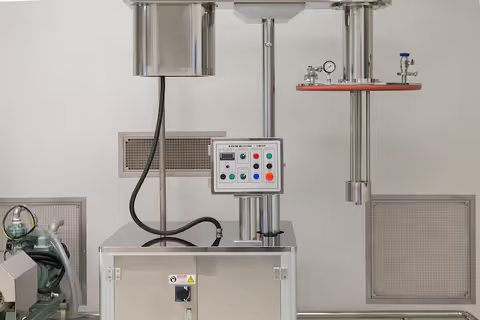
Industrial mills are machines designed to reduce the size of solid materials through mechanical action. They play an important role in manufacturing by transforming raw materials into powders, granules, or smaller particles suitable for further processing.
Industrial mills are used across many sectors, including mining, construction, food processing, chemicals, recycling, ceramics, and energy production.
The concept of milling has existed for centuries. Early mills relied on water, wind, or manual power to grind grains and other materials. Modern industrial mills use electric motors, advanced controls, and specialized grinding mechanisms to process a wide variety of materials with greater consistency and efficiency.
Different materials require different milling technology. Hard minerals, soft powders, recycled materials, and food ingredients each have unique characteristics that influence the type of mill selected. Understanding these differences helps explain why many industries use specialized milling equipment rather than a single universal machine.
How Industrial Mills Work
Industrial mills apply mechanical force to reduce material size. Depending on the design, this force may involve impact, compression, shear, or attrition. As materials pass through the mill, repeated mechanical action gradually breaks them into smaller particles.
Most industrial mills include several common components:
- Feeding system that introduces material into the machine
- Grinding chamber where size reduction occurs
- Rotating or moving elements that apply force
- Discharge system that releases processed material
- Control system that monitors operating conditions
The exact design depends on the intended application and the physical properties of the material.
Common Types of Industrial Mills
Several types of industrial mills are widely used in manufacturing.
- Ball mills use rotating cylinders filled with grinding media to reduce material size through impact and friction.
- Hammer mills rely on rapidly rotating hammers to break materials into smaller pieces.
- Roller mills compress materials between rotating rollers for controlled particle reduction.
- Jet mills use high-speed streams of air to create particle collisions without mechanical grinding media.
- Pin mills use rotating pins to process powders and relatively soft materials.
- Colloid mills create fine dispersions by forcing materials through narrow gaps between rotating surfaces.
Each design is suited to particular materials, production requirements, and desired particle sizes.
Importance
Why Industrial Mills Matter
Industrial mills support manufacturing by preparing materials for later production stages. Uniform particle size can improve mixing, shaping, chemical reactions, packaging, and overall process consistency.
Many everyday products depend on milling technology during production. Examples include cement, flour, pigments, ceramics, fertilizers, recycled materials, batteries, cosmetics, paper products, and food ingredients.
Without appropriate milling processes, many manufacturing operations would encounter challenges related to inconsistent material size, reduced processing efficiency, and variations in finished product characteristics.
Material Applications
Industrial mills process an extensive range of materials across multiple industries.
| Industry | Common materials processed |
|---|---|
| Mining | Limestone, ore, coal, minerals |
| Construction | Cement, clinker, gypsum |
| Food processing | Grain, spices, sugar, coffee |
| Chemical manufacturing | Pigments, powders, catalysts |
| Recycling | Plastics, glass, electronic materials |
| Ceramics | Clay, silica, feldspar |
| Agriculture | Animal feed, seeds, fertilizer materials |
Different materials vary in hardness, moisture content, density, and abrasiveness. These characteristics influence milling technology selection and operating conditions.
Factors Affecting Milling Performance
Several factors influence milling efficiency and product quality.
Material hardness affects the amount of mechanical energy required for size reduction. Moisture content can influence material flow and may contribute to material sticking within the grinding chamber.
Particle size requirements determine how long materials remain inside the mill. Feed rate, rotational speed, grinding media, and equipment maintenance also contribute to overall performance.
Environmental conditions, including temperature and dust control, may influence milling operations depending on the application.
Recent Updates
Digital Monitoring Systems
Industrial mills increasingly incorporate digital monitoring technologies that collect operating information during production. Sensors can monitor vibration, temperature, motor load, rotational speed, and other operating parameters.
This information helps operators observe equipment performance and identify changes that may indicate wear or maintenance requirements.
Automation in Milling Technology
Automation continues to become more common across manufacturing facilities. Modern control systems can automatically adjust feed rates, monitor operating conditions, and maintain more consistent production settings.
Automation may also reduce manual intervention during routine operating conditions while allowing operators to review production information through centralized control systems.
Energy Efficiency Developments
Manufacturers continue developing industrial mills that improve energy utilization during grinding operations. Updated motor technologies, improved grinding chamber designs, and optimized process controls contribute to these developments.
Rather than relying solely on larger motors, many newer designs emphasize improving grinding efficiency through equipment geometry and process optimization.
Improved Wear-Resistant Materials
Grinding components experience continuous wear because of repeated contact with abrasive materials. Recent developments include improved wear-resistant alloys, ceramic liners, composite materials, and specialized coatings that extend component operating life under demanding conditions.
Longer-lasting components may also reduce maintenance interruptions in continuous production environments.
Laws or Policies
Industrial Safety Regulations
Industrial milling equipment operates under workplace safety regulations established by national authorities. In India, occupational safety requirements are addressed through legislation such as the Occupational Safety, Health and Working Conditions Code, along with related rules and standards applicable to industrial operations.
Employers are generally responsible for maintaining safe workplaces, providing appropriate training, and implementing hazard control measures where required.
Environmental Requirements
Many industrial milling processes generate dust, noise, and airborne particles. Environmental regulations may establish requirements for emissions, dust collection, waste handling, and workplace air quality.
Facilities processing minerals, chemicals, or recycled materials may also be subject to additional environmental approvals depending on the nature of their operations.
Machinery Standards
Industrial equipment is commonly manufactured according to national and international technical standards addressing machinery design, electrical safety, mechanical integrity, and operational performance.
Standards may also specify requirements for emergency stopping systems, machine guarding, electrical protection, warning labels, and operating documentation.
Compliance requirements vary according to equipment type, installation location, and applicable regulations.
Tools and Resources
Several resources help operators, engineers, and students better understand industrial mills and milling technology.
Useful references include:
- Manufacturer technical manuals explaining operating principles and maintenance procedures
- Material property databases containing information on hardness, density, moisture content, and particle characteristics
- Engineering handbooks covering grinding theory and equipment selection
- Industry association publications discussing manufacturing practices
- Government workplace safety websites providing guidance on machinery operation and industrial safety
- Educational institutions that publish research related to particle size reduction and process engineering
Engineering Calculators
Various engineering calculators assist with production planning and equipment evaluation. Examples include particle size calculations, motor power estimation, rotational speed calculations, throughput estimation, and material balance worksheets.
These tools provide general engineering estimates and should be interpreted alongside equipment specifications and technical documentation.
Maintenance Checklists
Maintenance records help monitor equipment condition over time. Typical inspection items include:
- Bearings
- Grinding media
- Wear liners
- Motor condition
- Belts and couplings
- Lubrication points
- Dust collection equipment
- Control systems
Routine documentation supports consistent equipment monitoring and maintenance planning.
FAQs
What are industrial mills used for?
Industrial mills reduce the size of solid materials so they can be processed more efficiently during manufacturing. They are widely used in mining, food processing, recycling, construction, chemical manufacturing, ceramics, and many other industries.
What types of industrial mills are commonly used?
Common industrial mills include ball mills, hammer mills, roller mills, jet mills, pin mills, and colloid mills. Each uses a different milling technology designed for particular material characteristics and processing requirements.
How does milling technology improve manufacturing?
Milling technology creates more uniform particle sizes that can improve material mixing, handling, packaging, and downstream manufacturing processes. Consistent particle size also supports more predictable production results.
What materials can industrial mills process?
Industrial mills can process minerals, cement materials, grains, chemicals, recycled plastics, glass, ceramics, pigments, fertilizers, biomass, and numerous other materials. The appropriate equipment depends on material hardness, moisture content, and desired particle size.
What factors should be considered when selecting industrial mills?
Important considerations include material properties, required particle size, production capacity, grinding method, energy consumption, maintenance requirements, dust control measures, and compatibility with the overall manufacturing process.
Conclusion
Industrial mills are fundamental components of modern manufacturing because they reduce raw materials into forms suitable for further processing. Different milling technology designs address a wide range of materials and production requirements across many industries. Ongoing developments in automation, digital monitoring, energy efficiency, and wear-resistant materials continue to influence industrial milling processes. Understanding the operating principles, material applications, and regulatory considerations provides useful context for how these machines support manufacturing around the world.