Laboratory Chromatographs Explained: Types, Techniques, and Analytical Applications
Laboratory chromatographs are analytical instruments used to separate, identify, and measure components within a mixture. The basic idea behind chromatography is that different substances move through a medium at different rates, allowing them to be separated and examined individually.
Modern laboratory chromatographs combine this separation process with detectors and computer software to generate measurable results.
Chromatography has its roots in early laboratory experiments involving the separation of plant pigments. Over time, the technique developed into several specialized forms that can analyze gases, liquids, and complex chemical mixtures. Today, Laboratory Chromatography Systems are used across research, manufacturing, environmental testing, food analysis, pharmaceutical research, and academic laboratories.
The term chromatograph generally refers to the instrument used to perform and record a chromatographic analysis. Analytical Chromatography Equipment can range from relatively straightforward systems for routine measurements to highly automated configurations that combine separation, detection, data processing, and sample handling.
How Chromatography Works
Most chromatography systems contain a stationary phase and a mobile phase. The sample travels through or across the stationary phase with the help of the mobile phase. Because different compounds interact differently with these phases, they move at different speeds and become separated.
The separated compounds then reach a detector. The detector converts their presence into signals, which software displays as a chromatogram. Peaks on the chromatogram can provide information about individual components and their relative amounts.
A typical workflow includes:
- Sample preparation: The material is prepared in a form suitable for the selected technique.
- Sample introduction: A measured quantity enters the chromatographic system.
- Separation: Components move through the stationary phase at different rates.
- Detection: A detector records signals associated with separated compounds.
- Data analysis: Software processes the signals and presents the results.
Major Types of Chromatography
Different chromatography methods are designed for different types of samples and analytical questions. Two widely used categories are liquid chromatography and gas chromatography.
| Chromatography type | Mobile phase | Typical sample characteristics | Common applications |
|---|---|---|---|
| HPLC | Liquid | Dissolved or extractable compounds | Chemical, food, pharmaceutical, and biological analysis |
| GC | Gas | Volatile and thermally stable compounds | Solvent, environmental, petroleum, and chemical analysis |
| Ion chromatography | Liquid | Charged ions | Water and environmental analysis |
| Size-exclusion chromatography | Liquid | Molecules separated by size | Polymer and biological research |
| Thin-layer chromatography | Liquid solvent | Small samples | Screening and qualitative analysis |
The appropriate method depends on the chemical properties of the sample, the required detection capability, and the purpose of the analysis.
Importance
Chromatography matters because many materials contain several chemical compounds that cannot be distinguished reliably through visual inspection alone. Separating these components allows laboratories to study their composition and measure specific substances.
The technique is relevant to researchers, manufacturers, environmental laboratories, food laboratories, educational institutions, and quality-control teams. It can also support investigations involving water, soil, air, food ingredients, industrial chemicals, and biological samples.
Role in Laboratory Analysis
Laboratory chromatographs can help answer questions such as:
- What compounds are present in a sample?
- How much of a particular compound is present?
- Are two samples chemically similar?
- Has a material changed during storage or processing?
- Does a sample contain unexpected components?
The answer depends on the chromatography method, detector, calibration procedure, sample preparation, and analytical conditions. Chromatography results therefore need to be interpreted within the context of the particular testing method.
HPLC Laboratory Systems
HPLC stands for high-performance liquid chromatography. HPLC Laboratory Systems use a liquid mobile phase that is pushed through a column under pressure. Different compounds interact with the column material in different ways and therefore leave the column at different times.
HPLC is commonly used for compounds that are not suitable for gas chromatography because they may not vaporize easily or may degrade when heated. Depending on the configuration, HPLC can be combined with detectors that measure ultraviolet absorption, fluorescence, refractive index, or other properties.
GC Laboratory Equipment
Gas chromatography uses a gas as the mobile phase. A sample is introduced into the instrument and transported through a specialized column, where compounds separate according to their physical and chemical properties.
GC Laboratory Equipment is commonly associated with volatile or semi-volatile substances that can withstand the temperatures involved in the analysis. Applications include analysis of solvents, environmental samples, petroleum-related materials, fragrances, and other chemical mixtures.
Recent Updates
Laboratory chromatography has continued to develop through improvements in automation, detectors, software, data management, and instrument connectivity. From 2024 through 2026, the broader trend has been toward more integrated analytical workflows rather than isolated instruments.
Automation and Sample Handling
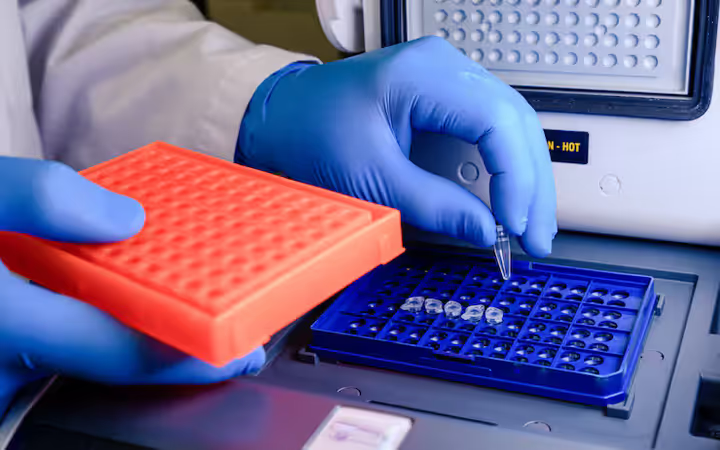
Automated sample handling is increasingly incorporated into Laboratory Chromatography Instruments. Autosamplers can introduce multiple samples according to programmed sequences, reducing repetitive manual operations and improving consistency between runs.
Automation can also be connected with laboratory information management systems. This allows sample identifiers, analytical sequences, results, and records to be linked within a broader laboratory workflow.
More Advanced Detection
Chromatography instruments are increasingly paired with sophisticated detectors. Mass spectrometry, for example, can provide additional information about molecular characteristics after chromatographic separation.
Other detector types remain useful for specific applications. The appropriate detector depends on the compounds being examined and the level of information required.
Improved Data Processing
Modern chromatography software can automatically process chromatograms, integrate peaks, compare results with reference data, and generate analytical reports. Data-management capabilities are also becoming more important as laboratories handle larger numbers of samples.
Digital records can improve traceability when appropriate controls are in place. Laboratories still need procedures for reviewing unexpected results, maintaining instrument records, controlling access, and protecting analytical data.
Greater Energy and Resource Awareness
Laboratories are also examining ways to reduce solvent use, waste generation, and energy consumption. This can involve smaller sample volumes, optimized analytical methods, improved column selection, and more efficient instrument configurations.
These changes do not eliminate the need for appropriate laboratory procedures. Method validation and performance assessment remain important when analytical conditions are modified.
Laws or Policies
Chromatography laboratories are influenced by scientific standards, laboratory accreditation frameworks, environmental rules, chemical regulations, and data-management requirements. The applicable rules depend on the type of laboratory and the purpose of testing.
Indian Regulatory Framework
In India, laboratories performing testing and calibration activities may work under accreditation frameworks administered by the National Accreditation Board for Testing and Calibration Laboratories (NABL). ISO/IEC 17025 is commonly associated with testing and calibration laboratories, while ISO 15189 applies to medical laboratories.
Laboratories may also need to follow requirements from relevant Indian authorities when their testing relates to food, environmental monitoring, industrial materials, or healthcare. For example, food laboratories can encounter requirements associated with the Food Safety and Standards Authority of India (FSSAI).
Environmental laboratories may operate within frameworks established under India's environmental laws and related standards. Requirements can include documented analytical procedures, equipment calibration, quality-control practices, and appropriate record keeping.
Chromatography results used for regulated activities may require validated analytical methods and traceable reference materials. The exact requirements vary according to the sample type, intended use, and regulatory framework involved.
Tools and Resources
A chromatography laboratory normally uses several supporting resources in addition to the chromatograph itself. These resources help with sample preparation, calibration, data analysis, documentation, and instrument management.
Laboratory Resources
Useful resources may include:
- Chromatography columns selected for particular separation requirements.
- Certified reference materials for calibration and method verification.
- Analytical balances for accurate sample preparation.
- Filtration equipment for preparing liquid samples.
- Data-analysis software for chromatogram processing.
- Laboratory information management systems for sample tracking.
- Instrument manuals and method-development documentation.
- Quality-control charts for monitoring analytical performance.
Organizations such as the National Institute of Standards and Technology (NIST), National Accreditation Board for Testing and Calibration Laboratories (NABL), United States Pharmacopeia, and European Pharmacopoeia provide technical or standards-related information relevant to analytical laboratories.
Scientific databases and chromatography method libraries can also help researchers understand established analytical approaches. However, published methods may need adjustment and validation for specific instruments, samples, and laboratory conditions.
FAQs
What are Laboratory Chromatographs used for?
Laboratory Chromatographs are used to separate and analyze components within mixtures. They are applied to chemical research, food analysis, environmental testing, biological research, industrial analysis, and other laboratory activities.
How do Laboratory Chromatography Systems work?
Laboratory Chromatography Systems move a sample through a stationary phase using a mobile phase. Different compounds travel at different rates, and a detector records the separated components as signals that can be displayed as a chromatogram.
What are HPLC Laboratory Systems used for?
HPLC Laboratory Systems are commonly used to analyze compounds that can be separated in a liquid mobile phase. They are used across chemical, food, biological, pharmaceutical research, and other analytical applications.
What is the difference between HPLC and GC Laboratory Equipment?
HPLC uses a liquid mobile phase, while GC uses a gas. HPLC is often used for compounds that are difficult to vaporize or may be affected by high temperatures, whereas GC is generally suited to volatile or thermally stable compounds.
What factors affect the choice of Laboratory Chromatography Instruments?
Selection depends on sample characteristics, the compounds being measured, required detection capability, expected sample volume, separation requirements, and laboratory workflow. Detector compatibility and data-processing requirements are also important considerations.
Conclusion
Laboratory chromatographs use controlled separation processes to help laboratories identify and measure components within complex mixtures. HPLC Laboratory Systems and GC Laboratory Equipment represent two major approaches, while other chromatography techniques address different analytical requirements. Recent developments have emphasized automation, integrated detection, digital data processing, and more efficient laboratory workflows. Proper method selection, calibration, quality control, documentation, and compliance with applicable laboratory standards remain important for reliable analytical work.